
What even is karma?
Most people would describe karma as “what goes around, comes around.” While that is true, Karma in Hinduism is way deeper. So deep that the principle of action and reaction operates on a multi-lifetime scale and not just a single life.
And within that, there are not one, not two, but four types of karma. And today, we’re diving into one of the most intriguing (and misunderstood) ones: Agami Karma.
Before we dive deep into Agami, let’s begin with understanding the 4 different types of Karma and the place that Agami stands on.
The 4 Types of Karma and Where Agami Stands
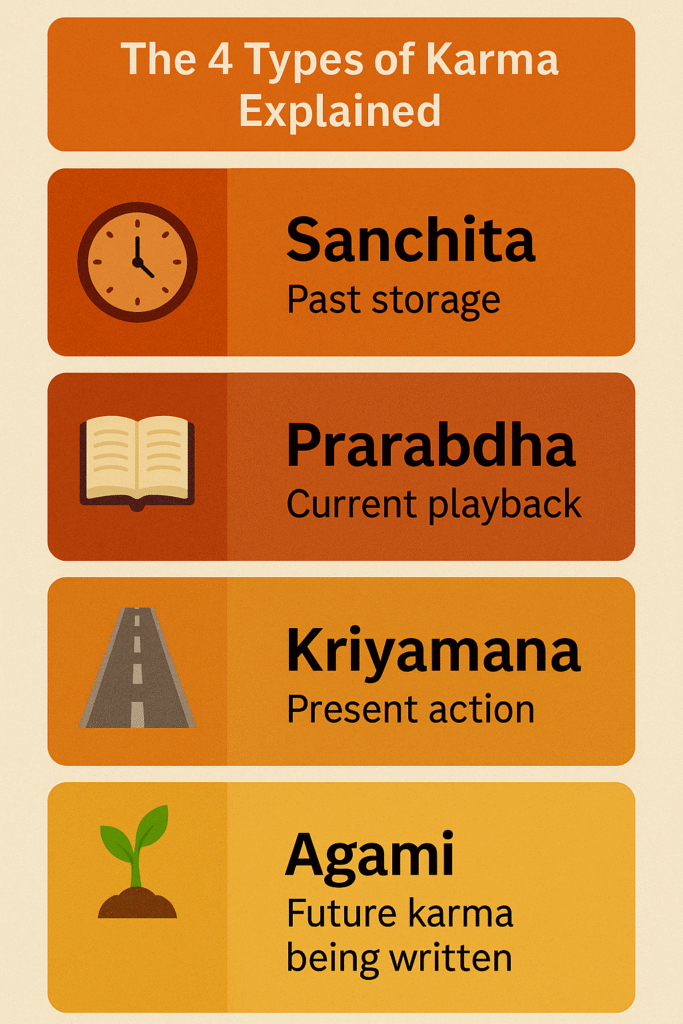
Sanatana Dharma doesn’t consist of a single Karma, but rather there are 4 distinct karmas categorized beautifully. They are:
- Sanchita Karma: Collection of the karma that you have accumulated in all your past lives.
- Prarabdha Karma : Prarabdha Karma is the portion of karma that is given to you in this life from the sanchita karma.
- Kriyamana Karma: The actions that you do in the present moment that create future karma.
- Agami Karma: The future karma being created based on your Kriyamana Karma (the action that you are doing right now).
Agami Karma Meaning Explained Simply
The word “Agami” comes from the Sanskrit root “gam,” meaning “to go” or “to arrive.” Add the prefix “ā” (toward), and you get “Agami,” meaning “that which is arriving,” a karma that is yet to come.
What is Agami Karma? Agami Karma Definition
To continue from above, Agami, meaning “that which is arriving”:
Agami Karma means the future karma that is being formed through your present actions, intentions, and even your silent thoughts.
Every action, intention, and thought that you are thinking right now is a Kriyamana Karma.
The jealousy, greed, taking advantage of others’ weak spots, lying when honesty would have served the highest good, and so on are negative Kriyamana leading to negative Agami; the secret compassion, selfless service, chaity, and donations are positive Kriyamana leading to positive Agami.
You can’t change your Sanchita. You can’t escape your Prarabdha Karma easily. But Agami? That’s where your power lies because you can always choose your Kriyamana Karma, which creates the Agami.
Agami Karma vs Kriyamana Karma?
Figuring out Agami Karma vs Kriyaman Karma can get confusing. Here’s a further simplification if you’re having trouble.
Kriyamana Karma is what you are doing right now, your action in motion (you are eating, drinking, helping others, or maybe taking advantage when you shouldn’t or being greedy).
Agami Karma is the result of that action – the karmic consequence that is yet to come.
Think of it like sowing and reaping. The sowing is Kriyamana; the harvest is Agami.
Every moment you’re doing Kriyamana Karma, you’re also writing your Agami Karma ledger.
Agami Karma may show up in the now, later, but usually it shows up in the next lives. Let’s understand this with an example.
Agami Karma examples
You might eat a lot of spicy foods alongside a lot of sour foods for days. This will result in an upset stomach very soon. This is agami karma showing up in the now.
Similarly, you may engage in years of charity, donations (dana), and the welfare of society. Such dharmic actions create a lot of positive Agami Karma, presenting fewer obstacles and more opportunities in your pursuit of building wealth through your free will.
However, these opportunities will most likely present themselves to you in your next life rather than in your immediate life.
To explore why it pays off in the next life, please refer to the ‘Karma in Hinduism’ blog, where I covered this in depth.
What is Agami Karma primarily concerned with?
As mentioned, agami karma is primarily concerned with your free will, your ability to shape your future through your current actions, thoughts, and intentions.
Unlike Prarabdha (which must be lived), Agami is still fluid. It’s being molded moment to moment, giving you full control over how you shape it to be!
If you sow positive Kriyamana (charity, being loyal and devoted to your spouse, engaging in seva to your dad, mom, elderly, in simple terms, acting in alignment with dharma), you will reap positive Agami in the future, and vice versa.
It’s all on your free will and how you choose to act on it.
How to Reduce Negative Agami Karma?
This is the real secret and the most hopeful one.
Because Agami Karma hasn’t fully manifested yet, it can be changed.
You can reduce negative Agami Karma through awareness, selfless service, devotion, meditation, and right intention.
Here’s what the Gita suggests:
योगस्थः कुरु कर्माणि सङ्गं त्यक्त्वा धनञ्जय ।
siddhy-asiddhyoḥ samo bhūtvā samatvaṁ yoga ucyate ॥ (Bhagavad Gita 2.48)
“Perform your duties established in yoga, giving up attachment, and remaining even-minded in success and failure – this equanimity is called Yoga.”
When you act without attachment, you burn the seeds of negative Agami Karma before they even sprout.
Other ways include:
- Engage in yoga, whether it be any: karma yoga, dhyana yoga, gyana yoga, or bhakti yoga, and so on.
- Engage in selfless seva, serve your father, mother, the elderly, and the needy ones.
- Be loyal, committed, and devoted to your spouse.
- Reflect before acting: ask if your choice aligns with dharma (right conduct).
- Always act dharmically, serving the highest good.
- Help without expectations of getting back.
- Engage in yoga, whether it be any: karma yoga, dhyana yoga, gyana yoga, or bhakti yoga, and so on.
FAQs
What is Agami Karma in English?
Agami Karma in English means “the future karma created by present actions.” It is the result that will manifest later based on what you think, say, and do now, in the present moment.
What is Agami Karma in palmistry?
In palmistry, some claim that certain lines or changes in palm patterns reflect Agami Karma, the karma currently being written through present actions. However, traditional Hindu scriptures do not mention Agami Karma in palmistry directly.
What is the Agami Karma Symbol?
There isn’t a scriptural symbol for Agami Karma. Hence, all the interpretations or symbolic representations lack any authoritative grounding.
Is Agami Karma good or bad?
Agami Karma itself is neutral. It becomes good or bad depending on your actions, intention, and awareness. Acting in harmony with dharma creates positive Agami Karma; acting in ignorance, greed, or selfishness creates negative.
Is it possible to change Agami Karma?
Yes. Since Agami Karma hasn’t yet ripened, it can be changed through conscious, selfless action, meditation, devotion, and right intention.
Does Agami Karma influence my present?
Mostly, it affects your future. However, some karmas bear fruit quickly. If you act with anger or kindness, you might feel the effect instantly – that’s a glimpse of Agami at work.
The Choice You Make Today…
…is the karma you’ll meet tomorrow.
Agami Karma is your spiritual credit card. Every swipe counts. But the good news is you’re holding the pen that writes your future.
Act with clarity. Think with compassion. Let go with wisdom.
Om Namo Narayanaya!
If you found this blog insightful, dive deeper into Hinduism’s timeless wisdom by exploring more articles on our website!
Read Next:

What is Vedic Astrology?
Vedic astrology, also known as Hindu astrology and Indian astrology is a knowledge given by…

Everything you need to know about Ashlesha Nakshatra
Ashlesha Nakshatra is the ninth Nakshatra out of 27 in Vedic astrology, falling within Cancer…

How to Read Vedic Astrology Chart
The Vedic Astrology chart, also known as Janma Kundali or Vedic Astrology birth chart is…

Who is Vishnu Bhagwan?
Vishnu Bhagwan, also famously known as Lord Narayana, is one of the most revered Bhagavan…

12 Houses of Astrology: What Each House Means in Your Life
When I first opened my birth chart, it felt like a wheel with 12 slices….
Who is Bhagvan Krishna?
Bhagvan Krishna, the eighth avatar of Lord Vishnu, the supreme cosmic preserver, is one of…

Leave a Reply